

















Healthcare workers are exhausted. A solution exists.
Constant demands and high stress wear down sleep, focus, and resilience across healthcare teams. Our non-invasive technology works alongside existing clinical and wellness programs to address the stress underneath.

The problem
Both sides of the exam room.
Health systems face a gap on both sides of the exam room. Clinicians carry long hours, broken sleep, and the weight of caring for others, with no recovery built in. Patients bring unexplained symptoms and sub-threshold anxiety that don't fit a clean referral, and often feel unheard.
Two sides of the same exam room. One regulatory gap neither side has a real answer for.
The mechanism
How it works.

A nervous system runs on two settings: sympathetic (alert) and parasympathetic (rest and repair). Clinical responsibility keeps healthcare workers in the first for whole shifts. For patients with unexplained symptoms, the same imbalance is often the driver, with no clear diagnosis. Both need the second.
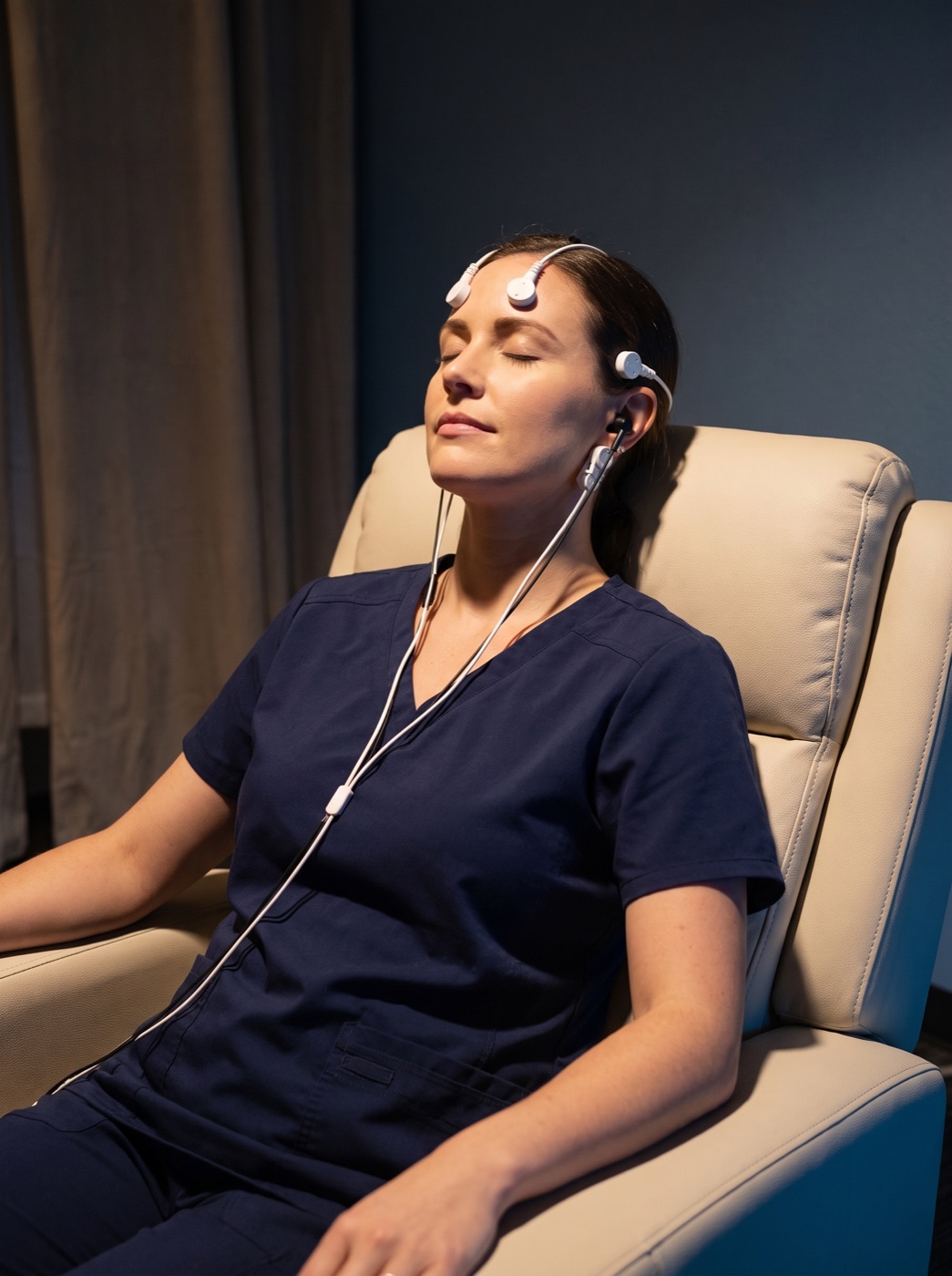
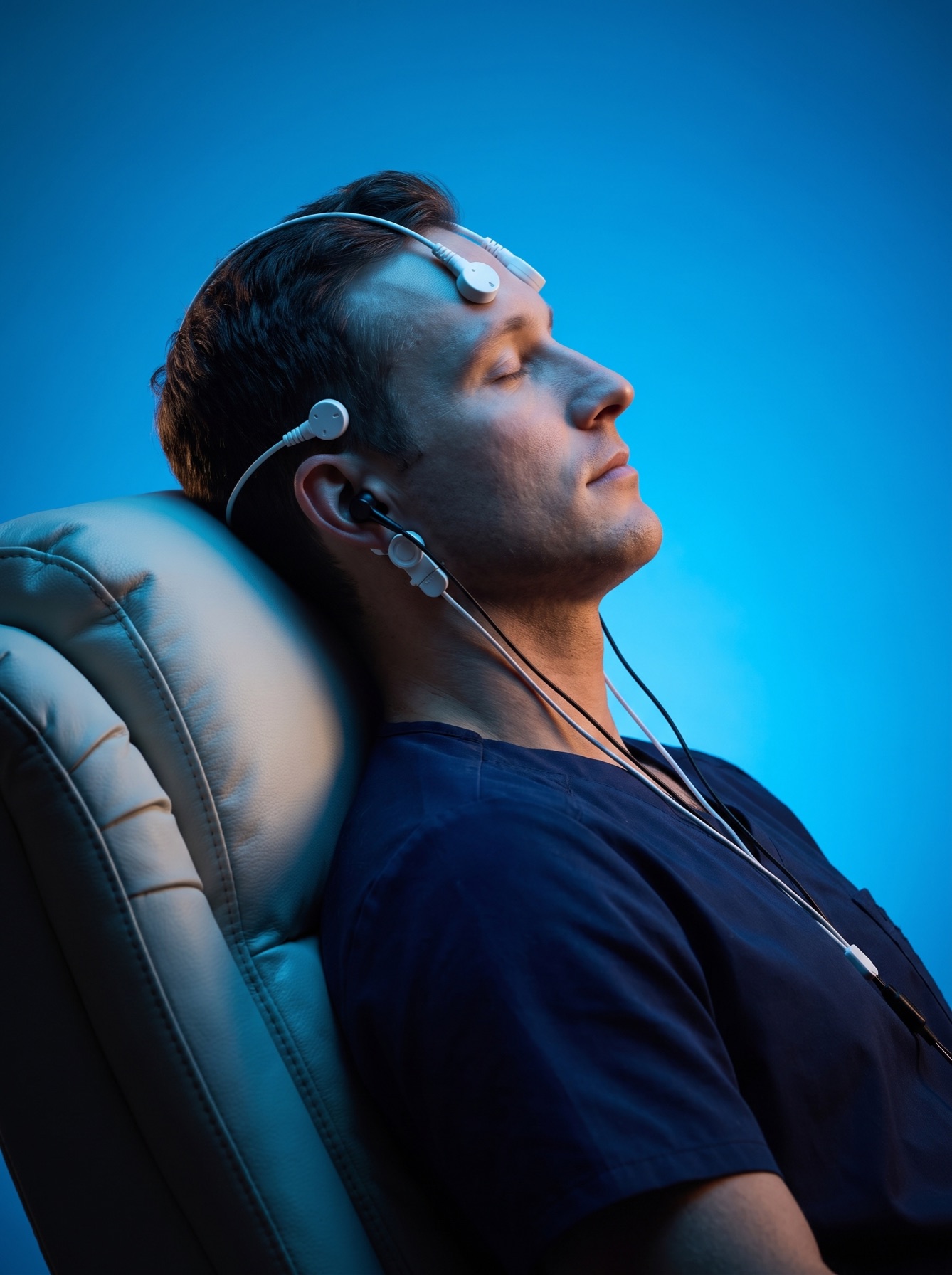
A few sensors read a person's brain activity in real time and play it back as sound, shifting as the brain shifts. There's nothing to do, no exercise, no script. Hearing that accurate reflection gives the brain what it needs to recalibrate itself.
Non-invasive. No medication, no medical procedure. The person rests.
See the mechanism
Reads brain electrical activity through a small number of patented sensors that are more sensitive than EEG sensors in a hospital. Converts dominant frequencies and hemispheric-balance data into audible engineered tones, near-real-time. No electrical, magnetic, or chemical input introduced at any point in the loop.
See more about the science
The autonomic nervous system's reach spans heart rate, blood pressure, digestion, immune and inflammatory response, sleep and wakefulness, stress hormones, all continuously communicating with each other rather than operating as isolated systems. Somatic symptom burden with no clear diagnostic home is often exactly this: a regulatory signal showing up across multiple physiological systems at once, not a single-organ problem with a single-specialist answer.
The research
The evidence, named directly.
This isn't a complementary therapy asking for trust on faith. It's a technology with a specific, citable research partnership behind it, and that partnership is the actual answer to "where's the evidence," not a marketing line standing in for one.
Years of research
15+
A 15-year collaboration with the Brain Body Research Program at Wake Forest University School of Medicine.
IRB-overseen studies
14
Populations including healthcare workers themselves.
Sessions in a course
5 or so
Across about 3 weeks. A defined referral, not an ongoing treatment relationship.
Medication
0 mg
Nothing enters the body. No medical procedure. The person rests.
Studies conducted through Wake Forest University School of Medicine.
The advantage
Three things holding each other up.
The case here isn't one point-solution against another. This is why the same referral option can serve both the medically-unexplained-symptoms patient and the burned-out clinician treating them, not two separate products.
The mechanism
A mechanism broad enough.
Supports regulation across the stress, sleep, and somatic symptom domains most primary-care referrals actually involve.
The research base
More than 15 years at an academic medical center.
A research base spanning more than 15 years at an academic medical center.
The relationships
The institutional relationships.
The ones that come with that history.
The comparison
How this compares to what's already being prescribed.
Psychiatric medication (SSRIs, SNRIs) changes neurotransmitter levels throughout the body. It helps many patients and can carry side effects, tolerance, or dependence. This technology is non-chemical: nothing enters the bloodstream, and it's designed to sit alongside a prescribing decision, not compete with it.

The protocol
The protocol, start to finish.
What a session addresses, from the first visit on.
A few minutes
A short assessment, not a new intake system
A few sensors, a few minutes, designed to sit alongside existing referral and workflow processes rather than requiring a new one.
40-55 minutes
The session
Private, roughly 40 to 55 minutes, delivered independent of a health system's existing EHR workflow. Referral and outcome summary handled directly between Innercore and the referring physician, not folded into a patient's existing chart without a deliberate integration decision.
5 or so sessions
A short course, not an open-ended prescription
Typically 5 or so sessions across about 3 weeks, positioned as a defined referral, not an ongoing treatment relationship competing with existing care.
Alongside existing care
Complementary, not a replacement
Designed to sit alongside existing clinical, wellness, and resilience strategies, not instead of them.
The session
Inside a session.
What changes
What changes.
For patients
A real referral option for patients whose symptoms don't have a clean specialist pathway.
Closing a gap in the care continuum rather than adding another waitlist.
Stepped care
A stepped-care option that complements, not competes with.
Existing behavioral-health referral pathways.
For clinicians
For healthcare workers.
The same regulatory support extended to the people delivering care, not just the patients receiving it.
Collaboration
Multidisciplinary collaboration described honestly as complementary.
Evidence-based care, not alternative medicine.
Common Questions
Are you wondering?
What's the actual evidence behind this, not just testimonials?
15+ years of research, a named academic partnership with Wake Forest University School of Medicine, and 14 IRB-overseen studies.
Is this covered by insurance, or an out-of-pocket cost for patients?
It depends on the partnership structure. We'll go over cost and coverage for your patients in your first conversation.
Does this replace or interfere with a patient's existing psychiatric or behavioral-health care?
No. It's designed to complement existing clinical, wellness, and resilience strategies, not replace them, consistent with a stepped-care or multidisciplinary approach rather than a standalone treatment.
Is this safe?
Yes. Non-invasive, no medication, no medical procedure. The sensors only listen; nothing is sent into the brain.
What does a session actually feel like?
Most people find it deeply restful. Many rest or sleep through it, similar to a quiet moment in a comfortable chair. Sensors on, earbuds in, nothing to practice or get right.
How long until I notice something?
Many people notice a shift by the second session, within a short, defined course of 5 or so sessions across about 3 weeks, not an open-ended commitment.
Start a referral conversation.
Not a treatment claim to evaluate on faith, and not a new administrative burden. A defined, evidence-based referral option for the patients your current pathways don't have a place for.