











The tired that sleep doesn't fix.
Eight hours in bed and you still wake up exhausted. Or you lie awake at 3am, wired, until the alarm. It's a nervous system that hasn't gotten the signal it's safe to rest.
The problem
Why sleep hygiene alone isn't enough.
Poor sleep isn't a rare complaint. It's close to the default experience for a huge share of adults, and most of what gets built to address it treats the symptom, better sheets, a stricter bedtime, a supplement stack, not the regulatory state underneath it.
Restorative sleep needs your nervous system to shift into rest and repair. When stress keeps it leaning toward alert, sleep doesn't come, doesn't stay, or doesn't restore. That's why sleep hygiene alone often isn't enough: it changes the room, not the state that produces sleep.
See more about the science
Your autonomic nervous system continuously adjusts your body's internal state: when to mobilize, when to conserve energy, when to shift toward rest, recovery, and restoration. Real, restorative sleep depends on that shift actually happening. When a nervous system remains activated long after whatever triggered it has passed, or simply has difficulty settling into the physiological state sleep requires, sleep becomes harder to reach and less restorative once it happens, no matter how much time is spent trying.
How it works
A reflection, not a directive.
Melatonin nudges one hormone and stops working when you stop taking it. White noise masks the room. A sleep tracker measures the problem in more detail. None of them reach what decides whether your brain can downshift. This does.
A nervous system runs on two settings: sympathetic (alert) and parasympathetic (rest and repair). A few sensors read your brain's activity in real time and play it back to you as sound. There's nothing to do. That reflection gives your brain what it needs to recalibrate toward the state sleep requires.
Non-invasive. No medication, no medical procedure. You rest.
See the mechanism
Reads brain electrical activity through a small number of patented sensors that are more sensitive than EEG sensors in a hospital. Converts dominant frequencies and hemispheric-balance data into audible engineered tones, near-real-time. No electrical, magnetic, or chemical input introduced at any point in the loop.
Not this
What this isn't.
Not a machine
Not a white noise machine.
It doesn't mask anything, it reads your actual brain activity.
Not a pill
Not melatonin, or any other supplement.
Nothing enters your body.
Not a script
Not hypnosis, and not a guided meditation.
There's no script, no voice, no suggestion to follow.
Not a tracker
Not a sleep tracker.
It doesn't just measure the problem, it responds to it in real time.
The research
Built on research, not a wellness trend.
Years of research
15+
A 15-year collaboration with the Brain Body Research Program at Wake Forest University School of Medicine.
IRB-overseen studies
14
Insomnia and sleep quality are directly among the conditions shown to improve, not an inferred benefit from a broader stress-relief claim.
Sessions in a course
5 or so
Across about 3 weeks. Not an ongoing routine.
Medication
0 mg
Nothing enters your body. No medical procedure. You rest.
Studies conducted through Wake Forest University School of Medicine.

The course
The course, start to finish.
What a session addresses, from the first visit on.
A few minutes
A short assessment
Not an intake. A few sensors, a few minutes.
40-55 minutes
The session
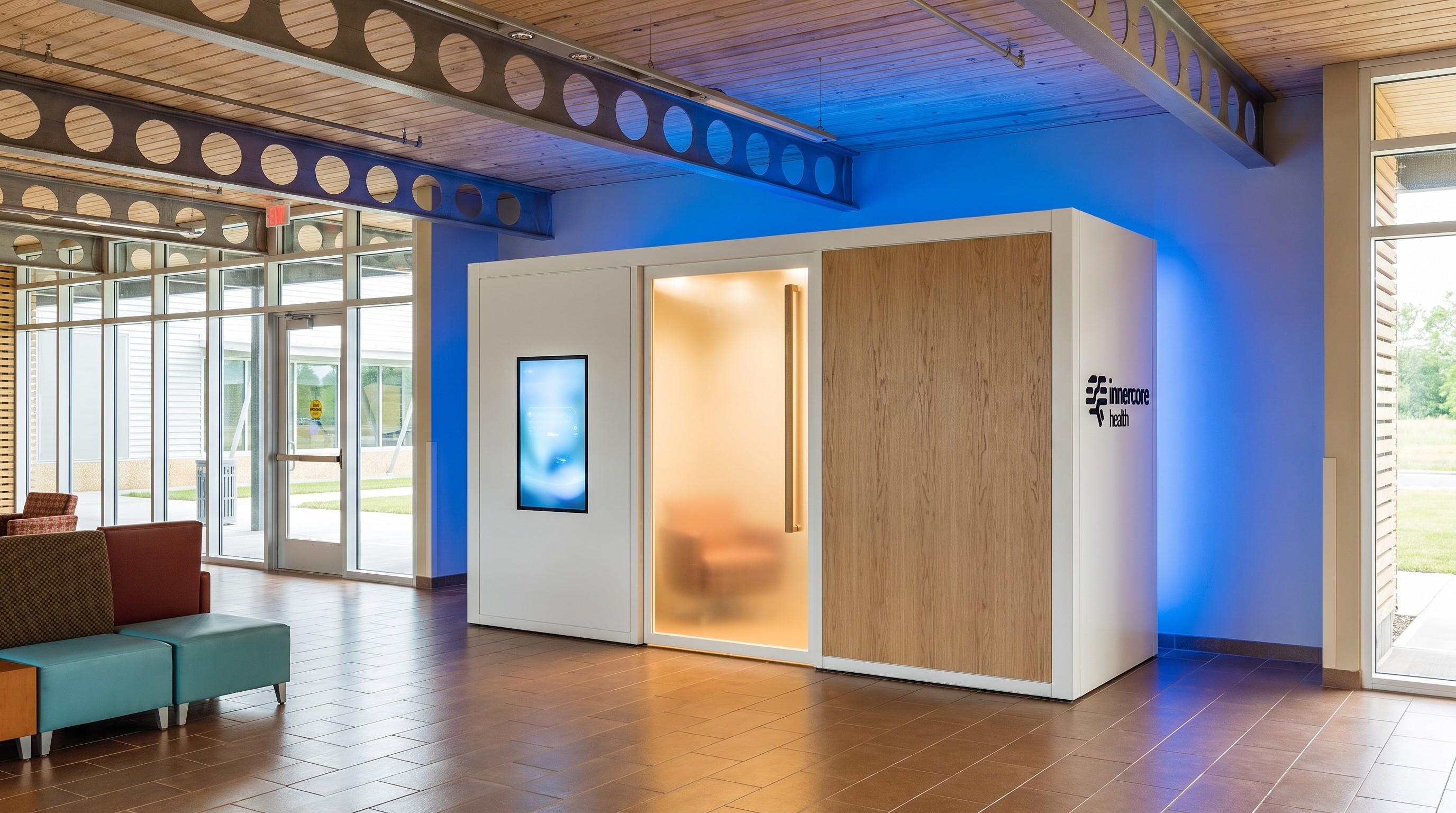
Private. Most people rest or sleep through the session.
5 or so sessions
A short course
Not an ongoing routine. Typically across about 3 weeks, with optional tune-up sessions afterward.
Sleep architecture
What's actually being tracked
The pattern and quality of sleep stages, not just total hours.

What changes
Session two. You lie back, sensors on, earbuds in.
Twenty minutes in, you're not thinking about the tone anymore. That night, asleep in under fifteen minutes. The 3am wake-up doesn't happen. Morning isn't perfect, but it's rested in a way eight hours in bed hasn't been in a long time.
- Actually falling asleep, not just eventually giving up and drifting off
- Staying asleep, without the 3am wide-awake stretch
- Waking up rested, not just waking up
- A brain that can go quiet at night instead of running the same loop on repeat
Beyond one condition
Sleep is rarely the whole story.
Who this tends to show up for.

Employers & Workforce Health
For 24/7 workforces and shift-based teams specifically, circadian mismatch is a named, structural driver, not just a symptom.
Explore

Students
"Can't turn my brain off at night" is this vertical's own top symptom phrase.
Explore

Women & Wellness
Postpartum sleep debt and perimenopausal fragmented sleep are both named drivers.
Explore

Military & Veterans
Sleep deprivation is the one universal throughline across both active-duty and veteran populations.
Explore

Brain Health & Wellness
The general wellness-literate consumer's own stated symptom set includes sleep disruption directly.
Explore
Common Questions
Are you wondering?
A few things people ask before their first session.
Is this instead of seeing a sleep doctor, or a substitute for treating sleep apnea or another diagnosed condition?
No. This addresses the nervous-system regulation piece of sleep difficulty, not diagnosed sleep disorders like apnea, which need their own clinical evaluation. If a diagnosed condition is in play, this is a complement to that care, not a replacement for it.
Do I need a sleep study or a diagnosis before trying this?
No. The initial assessment is a brief, sensor-based reading of your own brain activity, not a clinical diagnostic step. No prior diagnosis is required to start.
How is this different from a sleep app or melatonin?
Both work around the edges, environment or a single hormone pathway. This reads your own real-time brain activity and responds to it directly, addressing the autonomic state underneath sleep rather than trying to nudge it from outside.
Is this safe?
Yes. Non-invasive, no medication, no medical procedure. The sensors only listen; nothing is sent into the brain.
What does a session actually feel like?
Most people find it deeply restful. Many rest or sleep through it, similar to a quiet moment in a comfortable chair. Sensors on, earbuds in, nothing to practice or get right.
How long until I notice something?
Many people notice a shift by the second session, within a short, defined course of 5 or so sessions across about 3 weeks, not an open-ended commitment.
What does this cost, and is it covered by insurance?
Cost depends on the course that's right for you, or for organizations, on the partnership. We'll go over pricing, and whether insurance or a benefit plan can help, in your first conversation.
Start sleeping like sleep actually works.
Not another app, not another supplement. A short, private course built around what your nervous system needs to actually reach real sleep.